可以相交. 这里举一个水平渐近线(horizontal asymptote)的例子. 水平渐近线的定义如下:
假设 ![[公式]](https://www.zhihu.com/equation?tex=f) 是一个在区间
是一个在区间 ![[公式]](https://www.zhihu.com/equation?tex=%28a%2C%5Cinfty%29) 的函数. 若对于所有的
的函数. 若对于所有的 ![[公式]](https://www.zhihu.com/equation?tex=%5Cepsilon%3E0) 都存在一个对应的
都存在一个对应的 ![[公式]](https://www.zhihu.com/equation?tex=N) ,使得如果
,使得如果 ![[公式]](https://www.zhihu.com/equation?tex=x%3EN) ,则有
,则有![[公式]](https://www.zhihu.com/equation?tex=%7Cf%28x%29-L%7C%3C%5Cepsilon) ,则
,则 ![[公式]](https://www.zhihu.com/equation?tex=L) 称为函数 的水平渐近线.
称为函数 的水平渐近线.
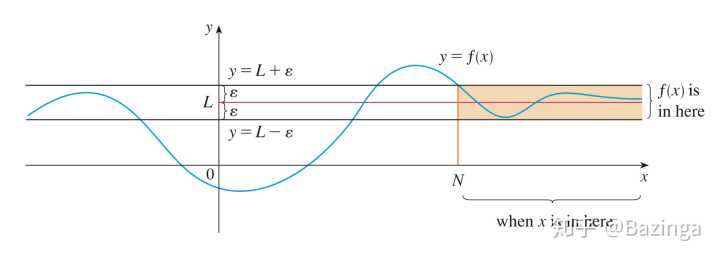 图示(来自Calculus Early Transcendentals ed8, Jame Stewart )
也就是说我们感兴趣的只是函数
在无穷远时的行为,在任何有限的区间内函数
的行为都无足轻重. 在图示中,函数
和
相交了不止一次,然而这仍然不会改变
是
的渐近线这一事实. 只要函数满足
![[公式]](https://www.zhihu.com/equation?tex=%5Clim_%7Bx+%5Crightarrow+%5Cinfty%7D%7Bf%28x%29%7D%3DL)
, 那么
就是函数
的渐近线.
当然图中的函数可能是随便画的,下面举一个例子.
考虑函数
![[公式]](https://www.zhihu.com/equation?tex=f%28x%29%3De%5E%7B-x%7D%5Cmathbb%7Bsin%7D%28nx%29)
, 其中
![[公式]](https://www.zhihu.com/equation?tex=n%5Cin+%5Cmathbb%7BZ%7D)
. 下面证明该函数的渐近线
![[公式]](https://www.zhihu.com/equation?tex=L%3D0)
.
证明: 由于
![[公式]](https://www.zhihu.com/equation?tex=-e%5E%7B-x%7D%3Ce%5E%7B-x%7D+%5Csin+%28n+x%29%3Ce%5E%7B-x%7D)
,
![[公式]](https://www.zhihu.com/equation?tex=%5Clim+_%7Bx+%5Crightarrow+%5Cinfty%7D+e%5E%7B-x%7D%3D%5Clim+_%7Bx+%5Crightarrow+%5Cinfty%7D%5Cleft%28-e%5E%7B-x%7D%5Cright%29%3D0)
, 根据夹逼定理,
![[公式]](https://www.zhihu.com/equation?tex=%5Clim+_%7Bx+%5Crightarrow+%5Cinfty%7D+e%5E%7B-x%7D+%5Csin+%28n+x%29%3D0)
.
![[公式]](https://www.zhihu.com/equation?tex=%5Csquare)
然而在Mathematica上画个图:
Plot[{Exp[-x]*Sin[10 x], Exp[-x], -Exp[-x]}, {x, 0, 5},
 PlotRange -> Full, PlotTheme -> "Detailed", GridLines -> None,
 Axes -> True]
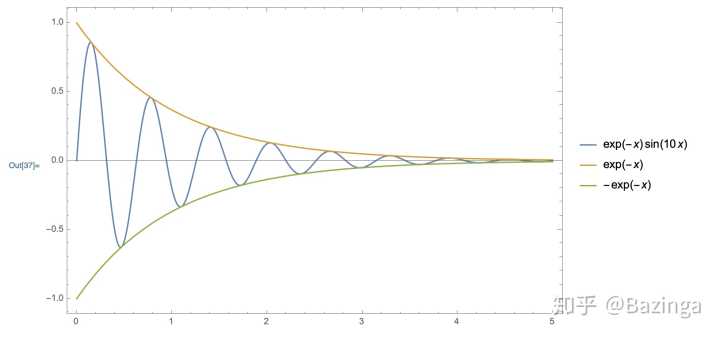
可以发现这个函数和0相交了无穷多次. 所以是可以的~